
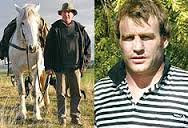
Central Otago high country farmer, Jim Hore has started to think about succession planning, but says it will be some time before he’s ready to completely hand over the reins to eldest son Charlie, and younger son, All Black hooker, Andrew Hore.
“Sue and I have no immediate plans to step aside yet. I’m still the bloody boss.”
Jim is the third generation of the Hore family to farm Stonehenge, a vast station near Patearoa in the Maniototo that was originally settled by his grandfather Chas in 1910.
At the moment Jim and Charlie are farming the station “in one big heap” with Andrew back on the farm when his rugby commitments allow.
At 35, and in the twilight of his international career, there has been a bit of media speculation about Andrew’s imminent retirement from top level sport, but that’s not something Jim will be drawn on.
He is just pleased that both his boys and their families (Charlie has a son and three daughters; and Andrew a son); will eventually be back on the station full time to carry on the proud family legacy carved out by the preceding generations.
“In the future the operation will probably be split in two, with Charlie farming Patearoa Station and Andrew at Stonehenge. But that’s a way off yet.”
The station carries around 22,000 sheep (merinos and halfbreds) and 400 Hereford cows and their calves which are fattened to two years olds.
All hoggets and calves are wintered on farm.
The Hore’s breed merino rams for sale to other studs and for use over commercial flocks.
Around 400 ha of the total property is irrigated which means all lambs and cattle can be sold prime to Silver Fern Farms.
Stonehenge’s relationship with the meat company goes back to 1936.
“They look after us and we look after them.”
The warm, dry summers and cold and dry winters at Stonehenge are the ideal conditions to produce the sort of high quality merino wool demanded by the market.
The station’s merino ewes produce around 5kg of wool, averaging between 17 and 18.5 microns.
Virtually all of the 90,000 kg of wool produced on the station ends up with clothing manufacturer Icebreaker, via Merino NZ.
The Hores were in the middle of shearing 5500 mainly merino hoggets when Business Rural South spoke to Jim recently.
He says he values the station’s longstanding relationships with shearer Paul Lyon from Alexandra and wool classer Barbara Newton from Dunedin, who has been a “big part of the place for the last 24 years”.
Barbara also wrote a book on the history of Stonehenge that was launched around 18 months ago, not long after the Hore’s celebrated a century under family ownership with a “very big party”.
She had written a couple of other local histories and says Jim was “adamant” he wanted her to help the family collect their stories, given her long connection with them.
Jim took over Stonehenge in the 1970s not long after he and Sue were married in 1972.
“I’ve had the same cook for 41 years,” he says, before handing the phone to Sue.
She has a rural background too, with both sides of her family longtime Taieri farmers.
For the last 40 years, feeding her family and their farm workers, musterers and visitors has taken up a fair bit of time for Sue, who is known for her hospitality.
“It still amazes me what you learn at the kitchen table over a cup of coffee.”
She says the highlights of their long tenure on the farm so far are “watching it develop and seeing the kids achieve”.
Stonehenge currently employs five staff in addition to Jim and Charlie.
Jim is a big fan of getting “the young ones” on horseback and out on the winter muster, one of his favourite times of the year.
“Using horses and camping out is a bit of a dying art but we love it.”
With the property so ingrained in his DNA, Jim says retiring off the farm one day is simply not an option.
“There are six bloody houses on this property. I’m not going anywhere.”
